HMRC’s Latest MSC Twist: Why ‘Actual Data’ Is a Double-Edged Sword — and How AI Can Help You Reclaim Your Numbers
It's not a five-minute fix, but AI is a more than useful aid in MSC enquiries
If you are one of the thousands of contractors caught up in HMRC’s long-running Managed Service Company (MSC) enquiries involving Boox and Churchill Knight (CK), you will know that the goalposts have a habit of moving just when you think you know where you stand. Between tribunal delays, standstill agreements dragging into the 2030s, and HMRC’s well-documented communication struggles, contractors have been left fighting an uphill battle against determinations that were originally issued on a "best judgement" basis.
Now, HMRC has shifted its approach again—asking contractors to supply ‘actual data’ to support the company accounts and CT600 returns originally submitted.
For contractors watching the discussions unfold on various forums and across social media, this latest demand feels like yet another fishing expedition. In reality, it is a classic double-edged sword. Understanding which side of that blade you are standing on and knowing how to audit your own records could make all the difference.
Additionally, there are two separate considerations here. First, are the figures HMRC is using an accurate reflection of what actually happened in your company? Second, does the MSC legislation apply to your circumstances? Reconstructing your accounts can help answer the first question and may provide useful evidence relevant to the second, but it still does not determine the MSC legal position on its own, unless of course it provides evidence that the second condition of the MSC legislation does not apply (that you drew less than 50% of the income generated on a cumulative basis).
The Double-Edged Sword of ‘Actual Data’
HMRC’s demand for underlying figures (turnover, allowable expenses, salary, dividends, and director loans or benefits) cuts two very different ways depending on how you actually operated your company:
- Those who followed a rigid formula: A small minority of contractors genuinely treated their company like a payroll conduit—following a set scheme, drawing down salary, expenses, and dividends to systematically wipe out turnover down to zero. If your records reflect a purely mechanical, provider-led extraction of funds with no independent commercial decision-making, supplying actual data will do very little to help you argue a "lack of involvement" defence.
- Those who ran their own business: The vast majority of contractors caught in this net simply thought they were hiring a modern, fixed-fee online accountant. You negotiated your own contracts, managed your own business bank account, and made your own financial decisions. For you, HMRC’s request for actual data is an opportunity. Where your original records no longer exist, you can build a retrospective reconciliation from contemporaneous evidence such as bank statements, invoices, payslips and HMRC online account records. Keep the reconstructions clearly identified as having been prepared retrospectively, but in tying them back year by year to the filed accounts, the resulting evidence may help demonstrate the extent to which you exercised genuine control over your company's finances and commercial decisions.
The problem, of course, is that many contractors no longer have easy access to their old portals or never kept parallel spreadsheets because they trusted their accountant’s software to do the job. Even when you do have the filed accounts, what sits on the Balance Sheet often bears little resemblance to reality.
Behind the Numbers: How ‘Ghost Figures’ Ended Up in Your Accounts
In a number of cases I have reviewed, balances shown as debtors or creditors in the filed accounts have been difficult to reconcile to identifiable transactions. This does not necessarily mean the accounts are wrong. Timing differences, tax balances and year-end accounting adjustments can all legitimately create debtor and creditor balances. However, where a balance cannot be matched to an identifiable asset, liability or transaction, it deserves further investigation.
The primary focus of these platforms was allocation: taking money received into your company bank account and pushing it into predefined buckets—salary, expense codes, and dividends. However, whenever an unexplained payment, a timing difference, or an unallocated invoice cropped up, the system didn't always flag it for human investigation.
In some of the cases I have reviewed, unresolved amounts appear to have remained within the accounting records and ultimately formed part of generic debtor or creditor balances at the year end. Where this has happened, the key task is to establish what those balances actually represent.
The same thing happened with tax overpayments. If you overpaid VAT, PAYE, or Corporation Tax, HMRC does not automatically refund that money unless a specific claim or request is made. In many cases, those unclaimed overpayments were left sitting on the Balance Sheet as a "debtor" asset, rolling forward year after year.
Because these figures were buried inside aggregated Balance Sheet totals, they were almost impossible for a non-accountant to spot—until you strip the numbers back to actual physical cash, real assets, and genuine liabilities, exposing the "ghost figures" left behind.
Using AI to Reconcile Your Bank Statements Against Filed Accounts
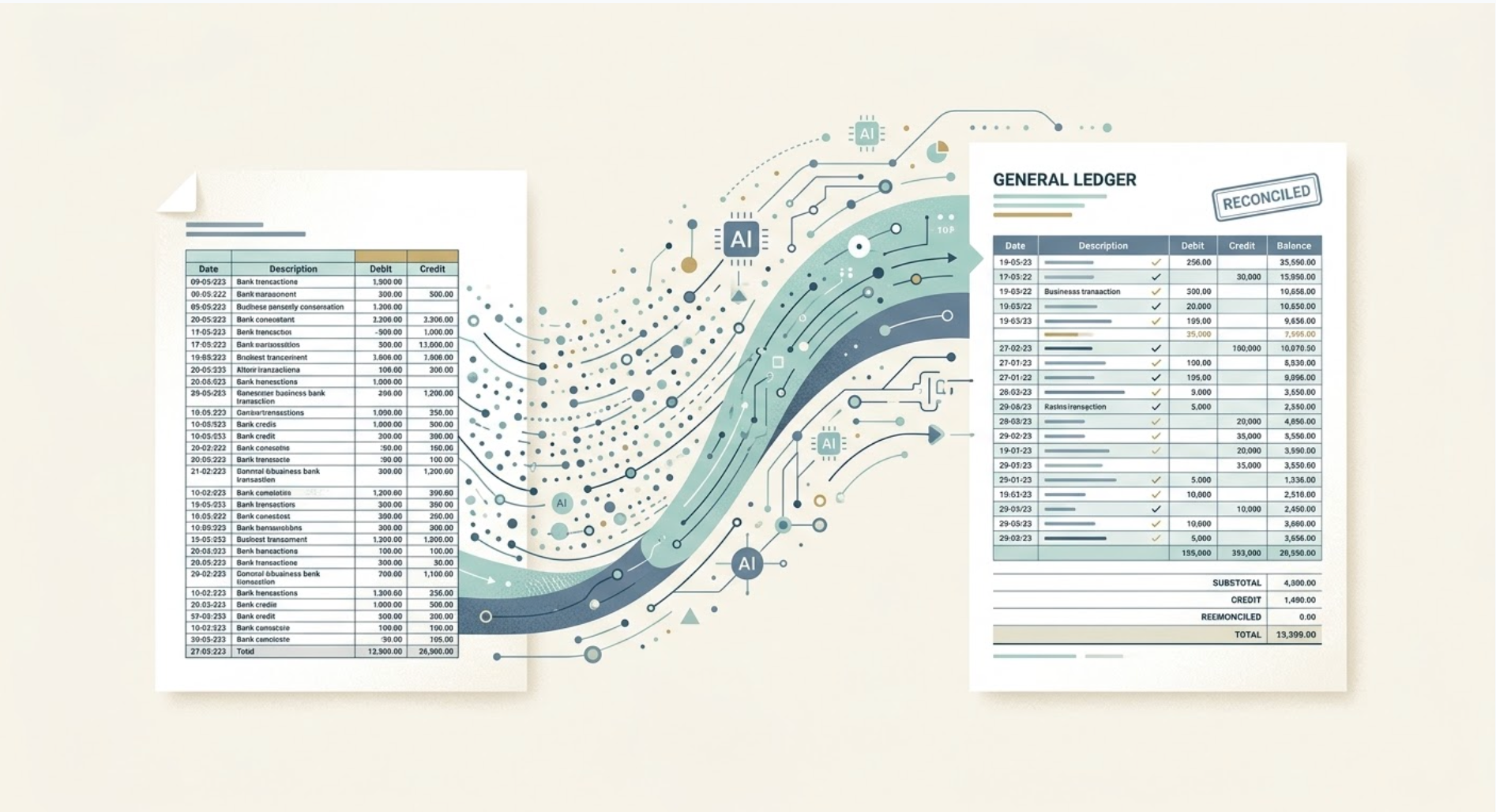
You do not need to pay thousands of pounds for a forensic audit just to establish your starting position. Today, pairing your raw bank statements with AI tools—such as Microsoft Copilot inside Excel, or Google Gemini alongside Excel or Apple Numbers—allows a non-accountancy professional to cut through the smokescreen and build an evidence trail HMRC cannot easily ignore.
Rather than trying to untangle years of messy software exports from the top down, work from the ground up using your bank statements as the foundation of the reconstruction. They provide an independent record of the cash that actually moved in and out of the company.
- Compile a Rudimentary Profit & Loss (P&L) by Tax/Accounting Year: Export your historical business bank statements into CSV or Excel format, grouped strictly by your company’s accounting periods. Use AI to help write formulas or categorise every line item into clear buckets: Client Income (Turnover), Allowable Business Expenses, Director’s Salary, Dividends Paid, Tax Payments (VAT, CT, PAYE), and Other/Unexplained Transfers.
- A crucial note if you were VAT-registered: Your bank statement shows gross figures, whereas your P&L must reflect net costs. For any standard-rated VAT-inclusive business expense paid out of the bank, remember that one-sixth (1/6) of the gross total represents the VAT element and needs to be reported in a separate VAT column with the remainder as the cost of purchase. Do not automatically apply this calculation to every outgoing.
- If you were on the Flat Rate Scheme specific rules apply.
- If you were on the VAT Flat Rate Scheme, different rules apply. In particular, if the Limited Cost Trader rate applied, make sure your reconstruction reflects the appropriate Flat Rate Scheme treatment for the relevant period. AI can help with these calculations.
- Construct a Draft Balance Sheet: From your categorised bank data and year-end bank balances, work with the AI to map out what your actual year-end position really looked like. At any given accounting year-end, your real assets and liabilities are straightforward:
- Assets: Actual cash in the bank on the final day of the accounting period, plus any unpaid client invoices raised before year-end that were paid after year-end.
- Liabilities: Unpaid supplier bills, actual Corporation Tax owed on that year's profit, and any unpaid VAT or PAYE due at that date.
- Compare Against Filed Accounts to Isolate Discrepancies: Place your reconstructed P&L and draft Balance Sheet side-by-side with the statutory accounts and CT600 returns submitted to Companies House and HMRC. Ask the AI to highlight the exact variances year by year.
By doing this, you immediately narrow the battlefield. Instead of defending an entire set of accounts blindfolded, you can pinpoint the exact discrepancies—whether that is an inflated "Other Debtors" balance caused by unallocated transactions, or an unclaimed PAYE/VAT overpayment—and focus your evidence solely on explaining those specific gaps.
A Realistic Warning: This Is Not a Quick Fix
Don't panic if you no longer have perfect records. The objective is not to manufacture a replacement set of books. It is to gather the evidence that still exists, establish what can be verified, identify what cannot, and reconcile that evidence as far as reasonably possible to the figures previously reported.
Helping my own clients untangle what their previous accountants actually filed by cross-referencing historic bank feeds against CT600s, checking HMRC’s various online portals (such as PAYE, VAT, and Corporation Tax ledgers to see what HMRC actually holds versus what the accounts claim) has taken many, many hours of painstaking work. Even with AI guiding you through the spreadsheet formulas and categorisation, you should expect this exercise to take days and days of focused effort.
For a working contractor, days spent digging through historic bank statements is lost time that could otherwise be spent billing clients and generating income.
However, weigh that lost time against the alternative. Doing nothing means handing HMRC an unexplained set of legacy figures which risks leaving you on the hook for an inflated MSC tax and National Insurance bill, plus years of accruing interest.
Putting in the hard graft now to reconcile your real trading history could be crucial in establishing what actually happened within your company, challenging figures that do not reflect the underlying transactions, and providing evidence of the way you operated your business. That evidence may also be relevant to the wider MSC arguments, but the question of whether the MSC legislation applies ultimately depends on the statutory tests and the particular facts of your case.
Need a Second Pair of Eyes?
If you have reconstructed your figures and uncovered unexplained debtor/creditor balances, or if you need experienced support navigating HMRC’s systems to verify what tax has actually been paid and allocated, get in touch with me. Having spent years auditing these exact accounting methods and dealing directly with HMRC on MSC enquiries, I can help you make sense of the numbers before you submit your response.