Will Stricter Penalties Curb Dishonesty
Dishonest Taxpayers are in the Firing Line

The landscape of tax compliance is shifting. As the government seeks to close the persistent "tax gap"—the difference between the amount of tax that should, in theory, be paid to HMRC and what is actually collected—it has introduced a consultation exploring a new criminal offence: the reckless making of untrue statements or declarations in direct tax documents.
The intention is to provide prosecutors with a broader range of options, thereby allowing for lesser alternative charges in cases where dishonesty cannot be proven but reckless conduct is evident. Currently, the legal threshold for criminal prosecution in tax matters is exceptionally high, often requiring evidence of deliberate fraud or intentional deception. This new proposal aims to fill the "middle ground" between a simple administrative error and outright criminal fraud.
The Rationale: Closing the Tax Gap
The urgency of this proposal is rooted in the latest HMRC Tax Gap figures for 2024/25, which estimate the total loss to the Exchequer at 6.4% of total theoretical tax liability. Of significant concern to policymakers is the contribution of small businesses, which account for 62% of these total losses some of which is down to dishonest behaviour.
By targeting "reckless" behaviour—defined as failing to take reasonable care or ignoring the risk that a statement provided to HMRC might be untrue—the government is shifting the burden of accuracy onto the taxpayer. The government’s rationale is clear: if the system relies on self-assessment, the integrity of the data provided by the taxpayer is paramount, and they argue that existing civil penalties are insufficient to deter those who are indifferent to the truth, and that a criminal deterrent is necessary to shift behaviour among those who might otherwise "chance their arm" when submitting returns.
This initiative is part of a broader digital transformation. With the introduction of Making Tax Digital (MTD) for Income Tax arriving in April 2026, the government is providing small businesses, freelancers, and landlords with the digital tools to "get it right" in real-time. This proposed offence acts as the "stick" to MTD’s "carrot," signalling that while the government wants to facilitate easier compliance, it will no longer tolerate the "reckless" disregard for accuracy that facilitates significant tax losses.
Distinguishing Careless from Reckless
To understand how this might impact you and your business, it is vital to distinguish between a simple mistake and a "reckless" error. The following table outlines the government’s current interpretation of these behaviours.
Table 1: Careless v Reckless Error

Table 2 : Examples of Types of Behaviour
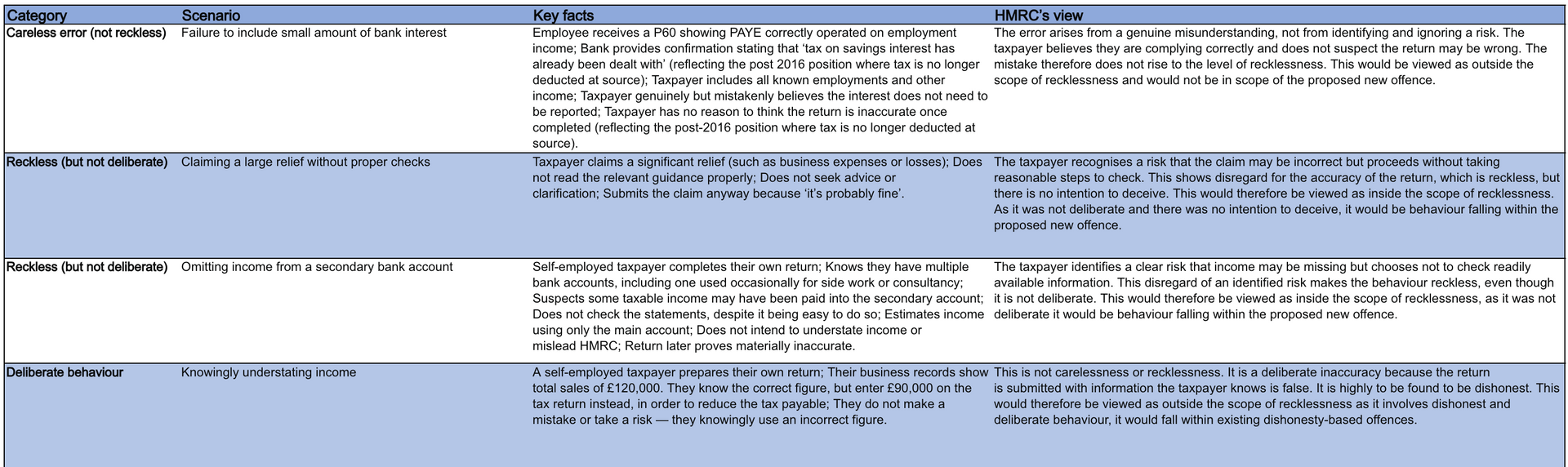
The Impact on small businesses, freelancers and landlords
For the average freelancer or landlord, this proposal should act as a prompt to review the accuracy of the figures supplied to HMRC on their Self-Assessment tax return. The government is essentially signalling that "I didn’t know" is not a valid defence, if the taxpayer was in a position to know but failed to take reasonable steps to verify the information.
If implemented, this new offence could lead to unlimited fines and the threat of imprisonment for those found guilty of recklessness. While the government maintains that this is intended for the "most serious" cases, the introduction of a new criminal threshold inevitably raises the stakes for every Self-Assessment return filed.
Conclusion: Is it enough to stop falsification?
Whether the threat of criminal prosecution will actually stop deliberate or reckless falsification remains to be seen. Critics might argue that small businesses often struggle with the complexity of the tax system, and that criminalising "recklessness" could inadvertently punish those who are simply overwhelmed by red tape rather than those attempting to cheat the system.
It is a shame that due to the actions of ‘bad actors’ who consistently under-declare income, or in other ways cheat HM Treasury, that millions of honest taxpayers will be terrified of the consequences of making a genuine mistake. We can only hope that HMRC is good to their word when it comes to honest taxpayers when they make the odd, honest mistake.
However, the government’s focus is undeniably on the bottom line. With 62% of tax losses originating from the small business sector, HMRC is clearly signaling that the era of "self-certification" is becoming increasingly audited. For taxpayers, the message is simple: as the digital tools for reporting tax improve via MTD, the tolerance for "reckless" errors is shrinking to zero. Professional due diligence is no longer just a best practice—it is becoming a vital shield against potential criminal liability.
Visit Gov.UK to read;
the consultation document..
...and the latest reported Tax Gap figures which are the catalyst for the more stringent controls over taxpayers tax affairs being proposed by the Government.
https://www.gov.uk/government/news/tax-gap-2024-25-estimated-at-64